

How Local SEO for Roofing Companies Drives Commercial and Residential Leads
I’ve spent years doing local SEO for roofing companies, and I’ve watched the right strategy turn small, one-truck contractors into the name everyone in town calls first. It’s rarely magic. It’s usually a handful of basics done properly and consistently.
In this guide, I’ll walk you through what those basics are: how to set up your Google Business Profile, which services to list, how to find the keywords your customers actually use, and how to combine SEO with paid ads when you need leads fast.
What a roofing business does, and why it matters
Roofing companies build, repair, replace and maintain roofs on homes, offices, warehouses and factories. If a homeowner has a leak, storm damage or a roof that’s simply worn out, they need a local roofer.
It’s hard to overstate how important that work is. The roof protects everything underneath it from sun, rain, wind and cold. When it fails, the damage spreads fast: rotting wood, mold, ruined insulation, higher energy bills and a big drop in property value.
That’s why demand never really goes away. New construction needs roofs. Storms create sudden waves of repair work. And every roof eventually reaches the end of its life. With the right local SEO strategy, a roofing company can tap into all of that demand, bringing in new customers every week and staying top of mind with past ones.
What does a great roofing business look like?
The roofers who dominate their local market usually have a few things in common. They’re properly licensed and insured. Their crews are experienced. They use quality materials and stand behind their work with a clear warranty.
Homeowners aren’t just shopping on price. A roof is a big, stressful purchase, so people want someone they can trust. That trust increasingly starts online, with a clear, helpful website, an active Google Business Profile, real reviews and a bit of social media presence that shows real jobs.
The best roofers also finish on time, price transparently, treat customers with respect and follow up after the job. Happy customers come back, and more importantly, they send their neighbors. For a local roofer, that word of mouth is still the most powerful marketing there is. Good local SEO simply amplifies it.
Why SEO matters so much for roofers
Think about what happens when someone spots a water stain on their ceiling. They grab their phone and search “roofing contractor near me” or “roof repair [city].” The roofers who show up on the first page get the calls. The ones on page three don’t.
SEO (search engine optimization) is the work of making your website and online profiles clear, credible and relevant enough that Google wants to show them for those searches. Done well, it works like a salesperson who never clocks out, bringing in new inquiries day and night.
Local SEO matters even more in roofing because customers want someone nearby, someone who can come out quickly, knows local weather and building codes, and will still be around if something goes wrong. If you rank well in your area, you rely less on paid ads, you win customers at a lower cost and your business becomes more profitable and stable over time.
23 roofing services worth listing
Most roofing companies do far more than they show online. Listing each service clearly, on your website and in your Google Business Profile, helps you show up for more specific searches. You don’t need to offer all of these. Pick the ones you actually do and build out from there.
1. Commercial roofing
Offices, warehouses, shopping centers, factories. These jobs are bigger and more technical than residential work, and the clients tend to stick with a roofer they trust for years.
2. Emergency roof repair
A tree comes down at 2 a.m., or a storm rips off half the shingles. Whoever answers the phone first usually gets the job. If you offer this, say so loudly.
3. Flat roofing
You’ll find flat roofs on most commercial buildings and a lot of modern homes. Drainage is everything here. Get it wrong and water just sits there.
4. Metal roofing
Steel, aluminum, even copper. Homeowners love metal because it lasts for decades and needs very little upkeep.
5. Roofing and siding
If your crew can handle the walls as well as the roof, tell people. Customers like dealing with one company instead of two.
6. Roof replacement
For most residential roofers, this is where the real money is. When a roof is simply worn out, patching it isn’t enough anymore.
7. Gutter installation and repair
Clogged or sagging gutters cause more roof and foundation damage than people realize. It’s also an easy add-on to almost any job.
8. Storm and hail damage repair
After a big storm, the phones light up. Many homeowners also want help documenting the damage for their insurance company, so mention it if you do.
9. Flat roof repair
Blisters, cracks, puddles that never dry. Small flat roof problems have a habit of turning into big ones inside the building.
10. Leaky roof repair
The drip in the living room is rarely right above the actual problem. Finding the true source is half the job, and it’s what separates good roofers from the rest.
11. Metal roof installation
A properly installed metal roof can outlast the mortgage. Installation quality matters a lot, so it’s worth showing photos of your work.
12. Metal roof repair
Rust spots, loose panels, backed-out screws. Catching these early can buy a metal roof many more years.
13. Roof cleaning
Dirt, algae streaks and piles of leaves don’t just look bad. They trap moisture and wear the roof out faster.
14. Roof ice and snow removal
In colder areas, heavy snow and ice dams can strain a roof and push water under the shingles. It’s seasonal work, but valuable.
15. Roof inspection
Home buyers want one before closing. Homeowners want one after a storm. It’s also one of the best ways to meet new customers who’ll need bigger work later.
16. Roof moss removal
Moss looks harmless, but it holds water against the roof like a sponge. In damp climates, this service is in steady demand.
17. General roof repair
Missing shingles, cracked tiles, bad flashing. The everyday repairs that keep a roofing business busy between bigger projects.
18. Roof sealing and coating
A good coating protects against water and UV damage, and reflective coatings can even help bring summer cooling bills down.
19. Residential roofing
The bread and butter for most roofers: new roofs, repairs and replacements on houses.
20. Rubber roofing (EPDM and TPO)
Walk onto the roof of almost any strip mall and there’s a good chance you’re standing on EPDM or TPO. These membranes are light and tough, and when they’re seamed properly, water has nowhere to go.
21. Slate roofing
Slate is gorgeous and can last a century, but not many roofers know how to work with it properly. If you do, that’s a real selling point.
22. Tile roof repair
Clay and concrete tile roofs are everywhere in the South and Southwest. Cracked or slipped tiles need someone who knows how to replace them without breaking the neighbors.
23. Business roof repair
Business owners don’t want to close for a day because of a leak. Working around their hours, early mornings or weekends, can win you loyal commercial clients.
How many people search for roofing on Google?
To get a sense of the opportunity, I looked at the roofing services keyword group in Semrush (September 2026). In the United States, it included 50,851 keywords with a combined monthly search volume of about 2.79 million. That’s nearly 2.8 million roofing-related searches every month.
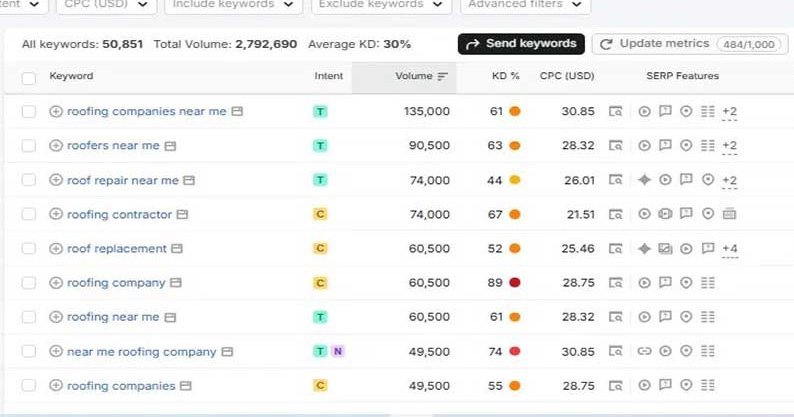
Three things stood out from this data.
The first thing I noticed was how many of the top keywords had “near me” in them. Nobody’s hiring a roofer from across the country. They want the guy down the street, and that’s the whole case for local SEO in one sentence.
Then there’s difficulty. The average came out around 30, which is middle of the road. Not easy, but not out of reach either. A newer roofing company with a sensible plan can absolutely compete.
Third, the average cost per click was around $21. That’s what competitors are paying Google Ads for a single click, not even a lead. It shows just how valuable these searches are. Organic rankings aren’t free, since they take time and effort, but once you earn them, you’re not paying for every visit.
7 steps to rank a roofing business on Google
There’s no secret formula here, just a sequence that works. You start with your Google Business Profile, because nothing else matters much until that’s right. Then you figure out what your customers are actually typing into Google, and build your website around those words. After that comes the less glamorous stuff: getting your details consistent across directories, building up reviews, and earning a few good local links. And the whole time, you keep an eye on the numbers so you know what’s paying off. Let’s take them one at a time.
Step 1: Your Google Business Profile
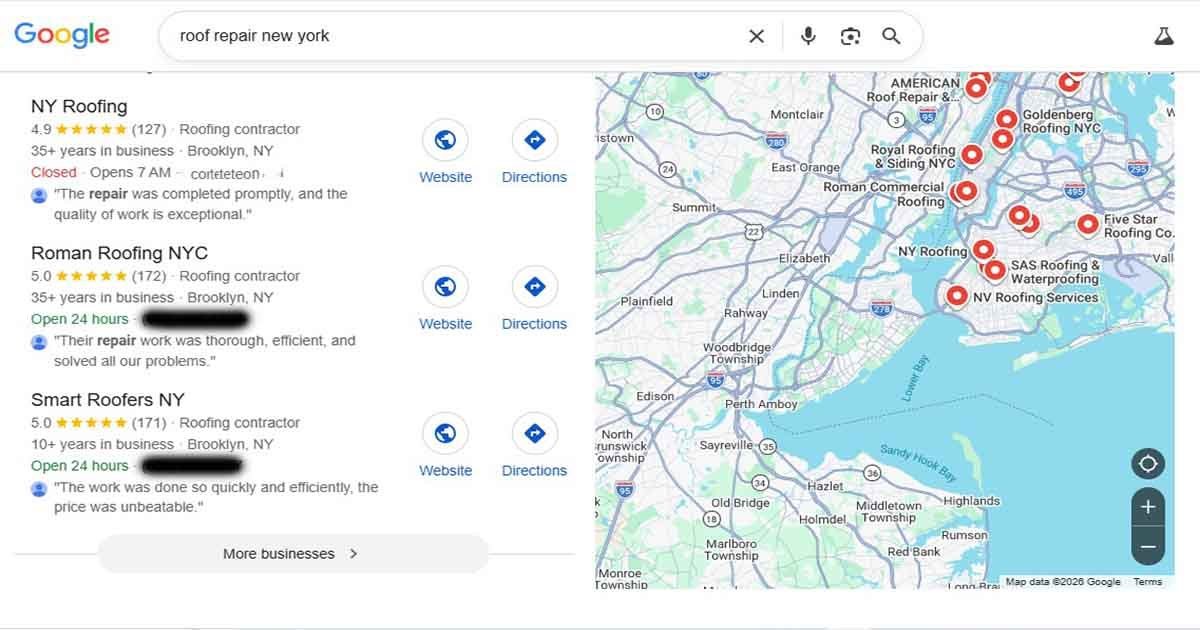
Your Google Business Profile is free, and for a roofer it’s often the most valuable marketing asset you have. When someone searches “roofers near me,” Google usually shows three local businesses with a map at the top of the results. That’s the Map Pack, or Local 3-Pack.
Getting into that box puts you in front of potential customers every day without paying for ads. Your profile shows your name, phone number, reviews, photos, hours and services all in one place. Many people call straight from there without ever visiting your website.
Set “Roofing contractor” as your primary category and list the services you really offer. Then load it up with photos of finished jobs. Honestly, a before-and-after shot of a storm-damaged roof does more selling than anything you could write in the description. Keep your hours right, too. Nothing annoys a homeowner with a leak more than calling a business that says it’s open and getting voicemail.
Step 2: Local keyword research
If you don’t know the exact words people in your area use to search for roofing services, it’s hard to reach them, no matter how good your website looks.
Someone rarely types just “roofing services.” They type things like “emergency roof repair Dallas,” “affordable roofers near me” or “metal roof installation Houston TX.” Keyword research shows you which phrases get searched, how competitive they are and what customers really want.
Target the right keywords and your service pages, blog posts and Google Business Profile posts reach the people who are ready to hire. Target the wrong ones and you can spend months ranking for searches that never turn into calls.
Step 3: On-page SEO
On-page SEO is about structuring your website so Google can instantly tell three things: where you work, what services you offer and why you’re a good choice in that area.
Google looks at your page titles, headings, content, image file names and meta descriptions. Your site should make it obvious that, for example, you’re a roofing contractor in Dallas offering roof repair, roof replacement and metal roofing.
The strongest roofing websites have a separate page for each main service and each main city they serve. Every page should use natural local keywords, explain the customer’s problem and how you solve it, include a clear call to action like “Call for a free inspection,” and use LocalBusiness schema markup. Real photos of your jobs help too, and if you’re curious about geo tagging images, see our separate guide on what it can and can’t do.
Good on-page SEO doesn’t just help rankings. It keeps visitors on your site longer, builds trust and turns more of them into paying customers.
Step 4: Local citations
Citations are mentions of your business name, address and phone number (NAP) on other websites, such as directories and review sites. Google compares these against your profile to check that your business is real and where you say it is.
For roofers, key sites include Yelp, Angi, BBB, HomeAdvisor and Yellow Pages. When your details match everywhere, Google gains confidence in your business. When they don’t, say a different phone number on one site, or “Street” in one place and “St.” in another, it creates confusion.
Inconsistent citations can quietly hold you back in the Map Pack even if your work and website are excellent. Audit them regularly and keep them accurate.
Step 5: Review management
For a roofer, reviews may be the single biggest factor in whether someone picks up the phone. A roof replacement can cost thousands of dollars, so homeowners want proof that past customers were happy and that problems got handled well.
Make asking for reviews part of your process. After every job, send the customer a text or email with a direct link to your Google review page. Thank people for positive reviews, and reply to negative ones quickly, calmly and professionally. A thoughtful response to a complaint often builds more trust than a five-star review.
One important rule: never offer discounts or rewards in exchange for reviews. It’s against Google’s policies.
Step 6: Local link building
Links from other websites work like votes of confidence. When respected local sites link to you, Google sees your business as more credible and more connected to your community.
Roofing is competitive, and many companies target the same keywords. Local backlinks are one of the things that separate the top-ranked roofers from the rest.
Some great sources: local news coverage of community projects, chamber of commerce membership, sponsorships of schools, sports teams, churches, mosques or community events, and referral partnerships with local businesses like real estate agents, home inspectors and hardware stores. These links help your rankings, and they also make your name familiar in the community, which drives word-of-mouth referrals.
Step 7: Tracking and reporting
SEO is an ongoing process, and without tracking it’s impossible to know what’s working.
Google Search Console, Google Analytics and your Google Business Profile performance data show you which keywords bring visitors, which pages they read, how long they stay, how many click to call and how many find you on Maps. Review these numbers every month.
With good data, you can see which keywords are climbing, which pages bring in the most leads and how many new jobs came from your online presence. That makes it much easier to decide where to focus next.
What if you need results quickly?
SEO is a long-term strategy. You’ll often start seeing movement within a few months, but real momentum takes longer. If you need leads now, paid ads can get you to the top of Google almost immediately. These three work especially well for roofers.
Google Local Services Ads (LSA)
Local Services Ads are usually the best paid option for roofing companies. Your business appears at the very top of Google with a verification badge, and you pay per lead rather than per click. With the average roofing job worth thousands of dollars, a single good lead can easily cover the cost.
Google Search Ads (PPC)
Target high-intent phrases like “roof repair near me” or “emergency roofer [city].” These bring urgent customers straight to your website. Keep in mind that the traffic stops the moment you stop paying.
Facebook and Instagram ads
Use location targeting to show your finished projects and offers to homeowners in your service area. Seasonal campaigns after storms or before winter tend to perform especially well.
The smartest approach is to run paid ads and SEO together. Ads bring in customers now while your SEO builds up in the background. As your organic rankings grow and you start to see how SEO helps roofing companies win more local leads, you can gradually reduce your ad spend. That balance keeps your business healthy in both the short and long term.
Final thoughts
We’ve covered a lot: what makes a strong roofing business, why local SEO matters so much in this industry, 23 services worth listing, and the 7 steps to climb Google’s rankings.
Every day, people in your area search for “roofer near me.” Your job is to make sure they find you. Set up and optimize your Google Business Profile, build out your website with the right local keywords, collect genuine reviews, keep your citations consistent, and use paid ads when you need a boost.
Local SEO for roofing companies isn’t just an expense. Done right, it’s one of the best long-term investments a roofer can make. Your competitors are probably already working on it, so there’s no better time to start than today.
Want help getting your roofing company to the top of local search? Get in touch with our team.